Section 3
Digests & Periodic Summaries
Two digest features that solve the two recurring inbox problems every professional has: "I subscribe to too many newsletters to read" and "I've handed my inbox to an AI and now have no idea what it's doing."
Newsletter Digest — for the high-subscription-volume professional
Target user: the knowledge-work professional whose job requires staying current on a high-volume subscription feed. The research clinician subscribed to journal alerts + NIH funding announcements + IRB digests + society newsletters + sponsor communications. The financial analyst tracking 12 industry briefings. The consultant signed up for every category-defining substack in their vertical.
For someone like this, newsletter overload is a 60-to-90-minute-per-day problem. Each newsletter has 2–4 articles worth a 30-second scan; only 5–10% of those articles deserve a real read. The current state-of-the-art is Cmd+A → Archive — losing the signal entirely.
The newsletter digest replaces that with one inbox entry at a scheduled time (typically 7 AM local, operator-configurable):
- The digest action pulls every newsletter-category message from the lookback window (default 24 hours)
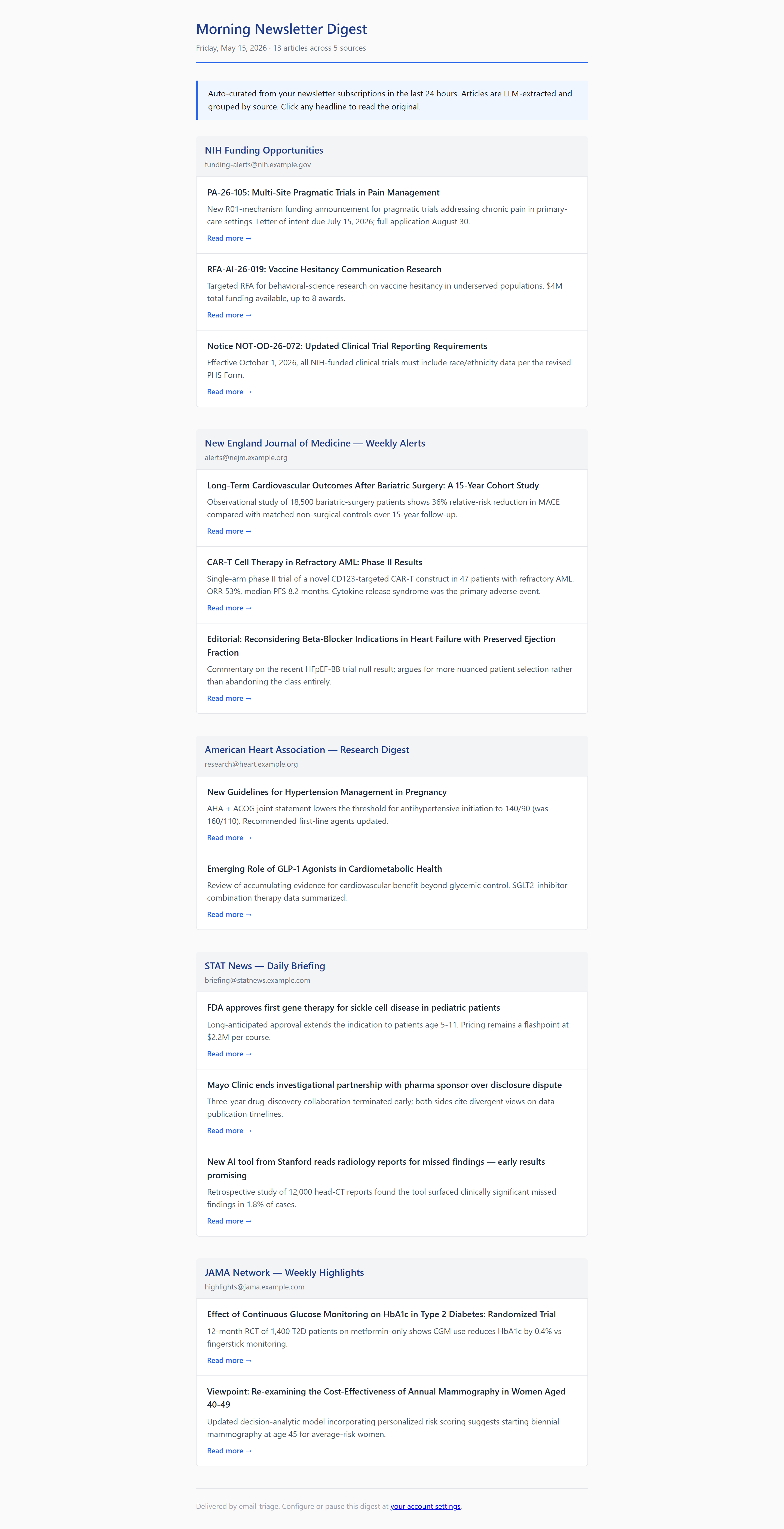
- The local LLM reads each newsletter body and extracts per-article structure: headline, 1–2 sentence summary, "read more" link
- Articles are grouped by source so each newsletter's content clusters together
- An HTML digest renders with section headings per newsletter, article cards beneath, and "Read more" buttons linking back to the original article URLs
- The digest delivers to the account's own inbox (or sends, per operator policy)
Concrete outcome. A research clinician with 30 newsletter subscriptions averaging 3 articles each goes from "120 inbox entries the system can't help me with" to "one digest with 90 article cards I can scan in 5 minutes." The 5–10 articles worth a full read get a click-through; the other 80 are dismissed by closing the digest. Daily time saved: 60–90 minutes.
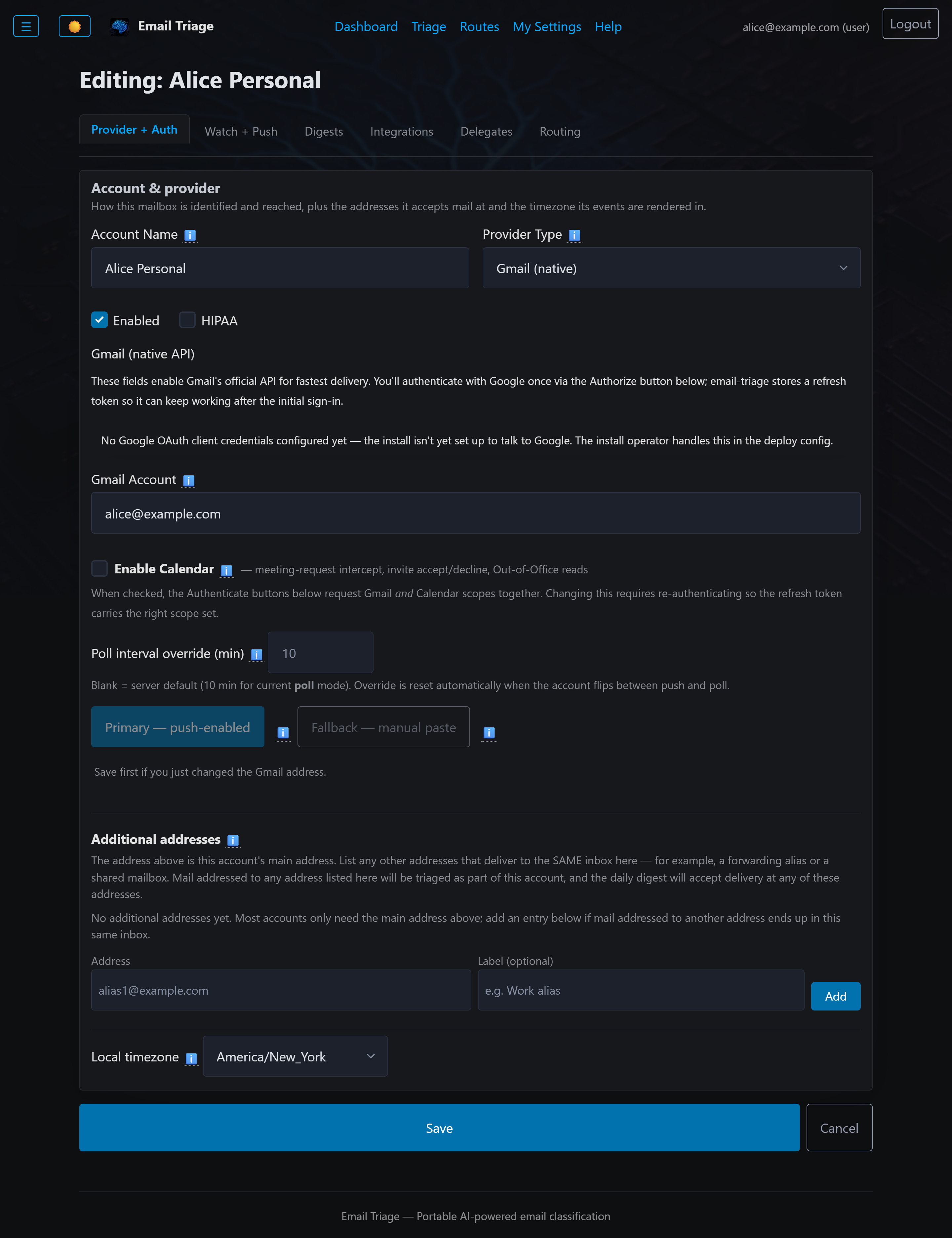
Configuration (per-account, on the Digests tab)
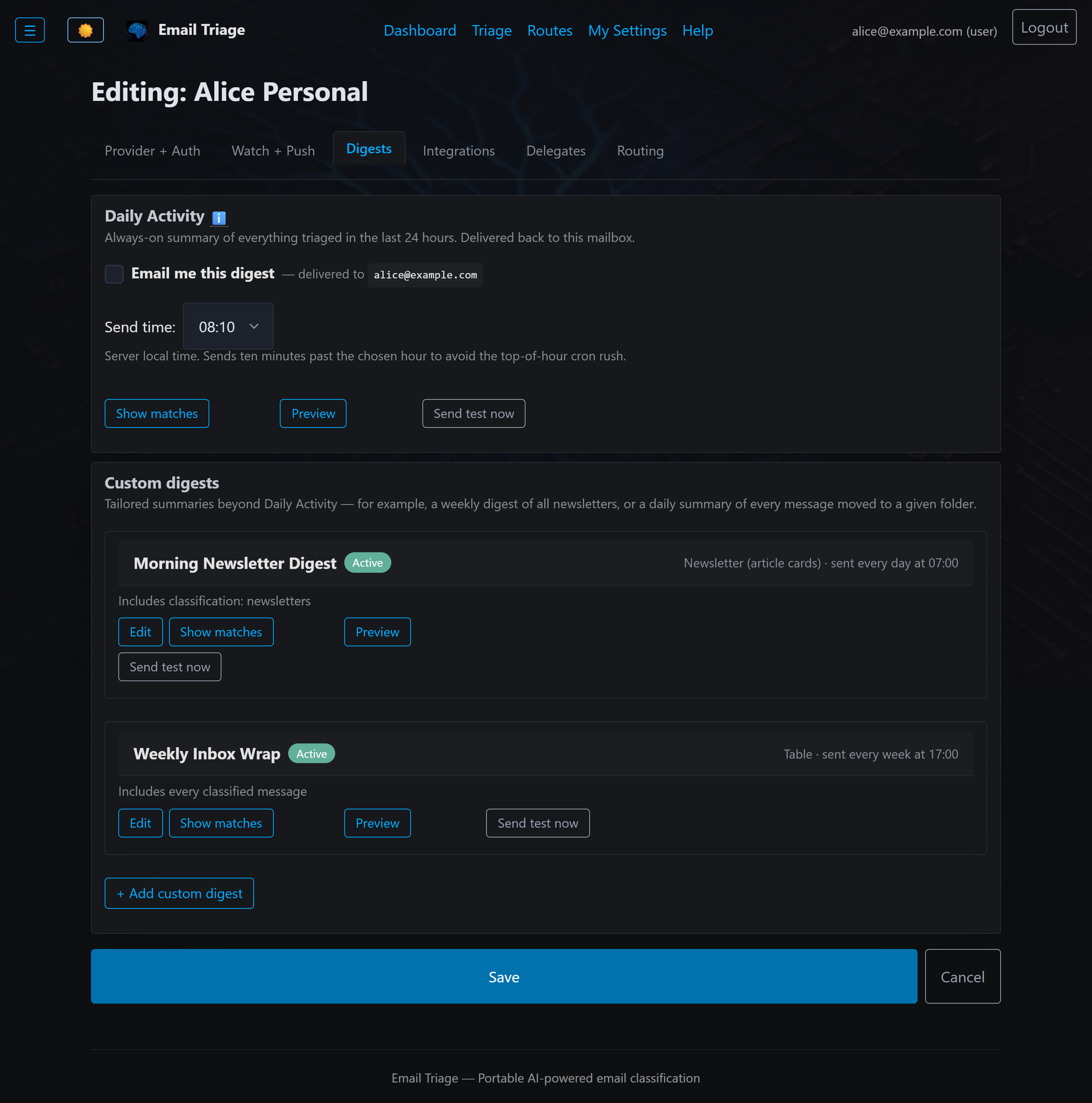
- Schedule — time of day in the account's timezone, days of week
- Categories included — defaults to
newsletters but can bundle any category (e.g. team-internal, comments for GitHub-style notifications)
- Lookback window — 24 hours for daily; 168 hours for weekly Monday digests
- Render template — HTML email shape; custom templates supported via the API for brand consistency
- Recipient — defaults to the account's own inbox; can be overridden for a "send digest to my assistant" pattern
Each schedule slot has an independent enable/disable toggle and a "Run now" button for previewing without waiting 24 hours.
/accounts/<id>/edit on the Digests tab — Daily Activity, custom digests (Morning Newsletter, Weekly Wrap), per-slot Preview and Send-test-now buttons
What a rendered newsletter digest looks like
The HTML body of a generated newsletter digest as it arrives in your inbox — section headings per source, article cards with headlines, 1–2 sentence summaries, and "Read more" links back to the original article URLs. The visual "30 emails → 1 digest" outcome:
A daily 7 AM newsletter digest — 12 articles across 5 sources (NIH funding, NEJM, AHA, STAT News, JAMA), each with a headline + summary + "Read more" link
Triage-Activity Digest — for the "I want to know what the AI is doing" user
The "set it and forget it" anti-pattern is real: an AI quietly classifies + drafts + moves mail for weeks, the operator's confidence drifts toward "I have no idea what it's doing," trust erodes, eventually the operator pulls the plug. The triage-activity digest is the antidote — every day, the operator gets a complete record of what email-triage did with their mail.
Daily summary delivered to the account's own mailbox at the scheduled time (typically end-of-day, 6 PM local — operator-configurable):
- Today's triage summary — counts per category ("47 newsletters, 12 to-respond, 8 meetings, 3 invoices"), counts per action ("12 drafts created, 47 moved, 8 labeled, 0 errors")
- Per-message detail — sender, subject, category, confidence, and the action chain that fired. Operator reads top-to-bottom in 2 minutes and knows exactly what got done.
- Drafts that need your attention — every saved draft linked back to the Drafts folder. Closes the "drafted reply forgotten in my Drafts folder" loop.
- Classification confidence flags — any message classified at <0.85 confidence surfaces here so the operator can correct via rules. Turns the digest into a tuning surface.
- Errors — anything that went wrong (auth failures, draft-creation errors, watch-rule webhook timeouts). Surfaces operational issues to the user, not just the admin.
The system never feels like it's acting on your behalf without your knowledge. Every classification, every action, every draft is in the digest. For HIPAA-regulated environments this doubles as a lightweight audit surface — the compliance officer reviews the operator's last 5 daily digests instead of querying the access log.
Compliance posture, locked in code
- Locked to the account. Delivery is to the account's own email address — never to a notify_email or third party. "What email-triage did to MY mail goes back into MY mailbox."
- Owner-only initially. Delegates of the account don't get their own opt-in surface yet — only the account owner can enable the digest.
- Recipient verification, hard. If the account's email address changes and the configured to-address no longer matches, the digest refuses to send with an audit-log row.
Delivery mechanics
- Supervised scheduler. Background worker polls every account's schedule slots once per minute and fires when a slot's wall-clock matches. Quarantine + auto-retry on transient failures.
- Idempotent fire. Each schedule slot tracks the last-fired timestamp — no double-fire within the same 60-second window even across a container restart.
- HIPAA-aware. Newsletter-digest action runs against the LLM (local Ollama by default; cloud only with BAA ack). Triage-activity digest renders only category names + action verbs + counts — no PHI in the digest body itself.