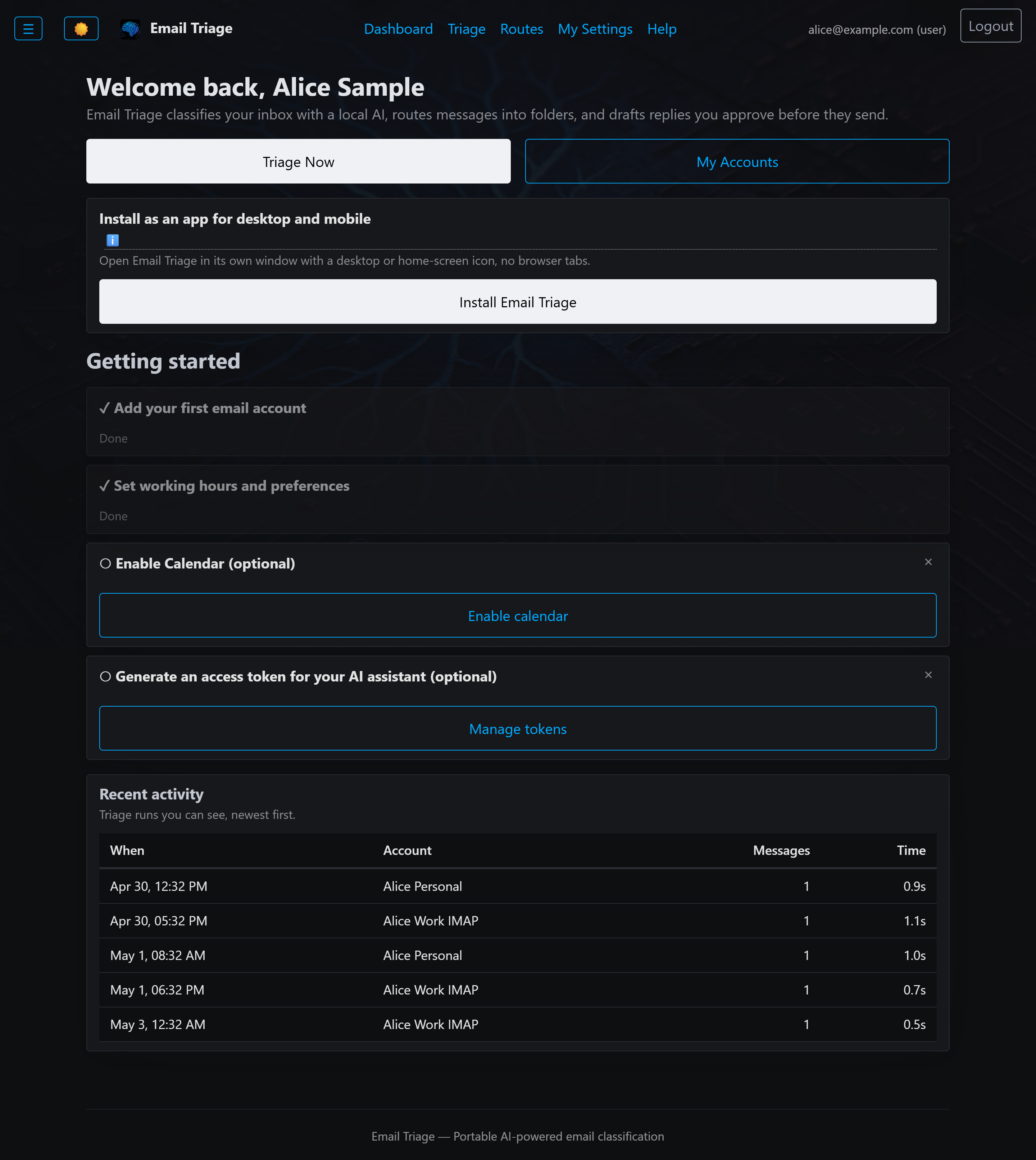
/dashboard — at-a-glance activity, classification stats, recent triage runs
Email Triage is a self-hosted email automation system that classifies, routes, drafts replies, schedules meetings, and produces aggregated digests — running on infrastructure you control. 60–90 minutes back. Every day. Sovereign AI by default. HIPAA-ready.
/dashboard — at-a-glance activity, classification stats, recent triage runs
The problem
Knowledge-worker email has four failures the inbox alone cannot solve.
A typical professional inbox is 70–80% mail that requires no action. The 20% that needs attention is buried.
Important mail sits unread for hours. Time-sensitive items — sponsor deadlines, IRB notices, security alerts — get missed.
Every response needs a courteous opening, substantive middle, and closing — even when the middle is "yes, 10am works."
Check calendar, pick 2–3 slots, write proposal, handle back-and-forth. The mechanical part is automatable.
Headline Capability
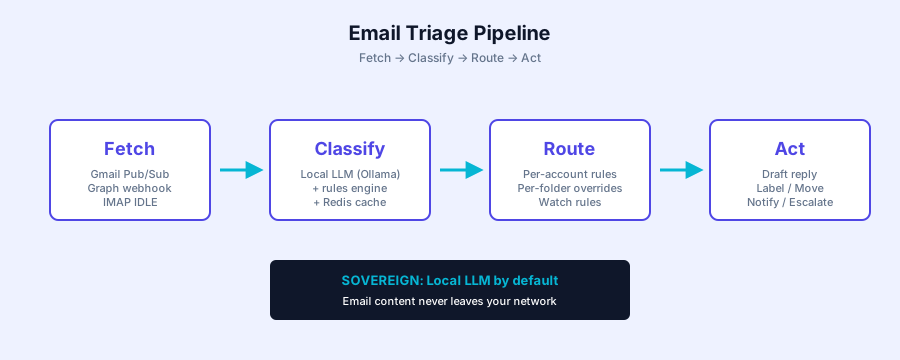
Your email stays inside your network. Always. By design. The classifier and drafter run on your own infrastructure — Ollama on a GPU you control. Cloud LLM backends are supported, but only for non-HIPAA accounts or after explicit BAA acknowledgment recorded in code, not policy.
Default Ollama backend with Qwen / Llama / Mistral families. Email content never traverses a third-party API. No SOC 2 boundary to argue about.
OpenAI / Gemini / OpenAI-compatible cloud backends supported. HIPAA-flagged messages skip cloud routing until BAA acknowledgment is recorded in the audit log. Code-enforced, not policy-enforced.
The RAG path (sent-mail context for drafted replies) is hard-coded to local-only. Adding a cloud embedding backend literally fails the build via static privacy-invariant tests.
How it works
New mail arrives. The classifier sorts it. The router applies your rules. Actions fire. Every classification produces an audit row showing which model, what category, how confident, what reasoning, what action.
Key differentiators
Local Ollama by default. Cloud backends supported with BAA gating. Hybrid patterns possible. You pick.
Single toggle enables PHI-scrubbed logs, recipient verification, redacted notifications, and cryptographic audit chain.
First-class Gmail (Pub/Sub push), Office 365 (Graph), and IMAP (IDLE). Multi-account, multi-provider.
Categories, routes, and actions are user-defined and visible in a web UI. No black-box behavior.
Reads your calendar, suggests free slots, drafts meeting-acceptance replies with proper iCal threading.
Newsletter digest collapses 30+ subscription feeds into one inbox entry at 7 AM with summarized article cards. Triage-activity digest at end-of-day shows you exactly what the system did with your mail.
27+ JSON endpoints with bearer auth, per-token rate limiting, HIPAA hard-off. Built for AI-agent tool-calling.
Killer feature for the high-subscription professional
The newsletter digest pulls every subscription feed from the last 24 hours, has the local LLM extract per-article structure (headline, summary, link), groups by source, and delivers one HTML digest to your inbox at 7 AM.
Research clinicians, financial analysts, consultants — anyone whose job requires staying current on a high-volume subscription feed — spend 60–90 minutes per day on newsletter skimming. Only 5–10% of articles deserve a real read.
From "120 inbox entries the system can't help me with" to "one digest with 90 article cards I can scan in 5 minutes." Click through the 5–10 worth reading. Close the tab on the rest. Daily time recovered: 60–90 minutes.
Companion triage-activity digest at end-of-day: counts per category, per-message detail, drafts awaiting review, low-confidence flags for rule tuning. You never lose visibility into what email-triage did with your mail.
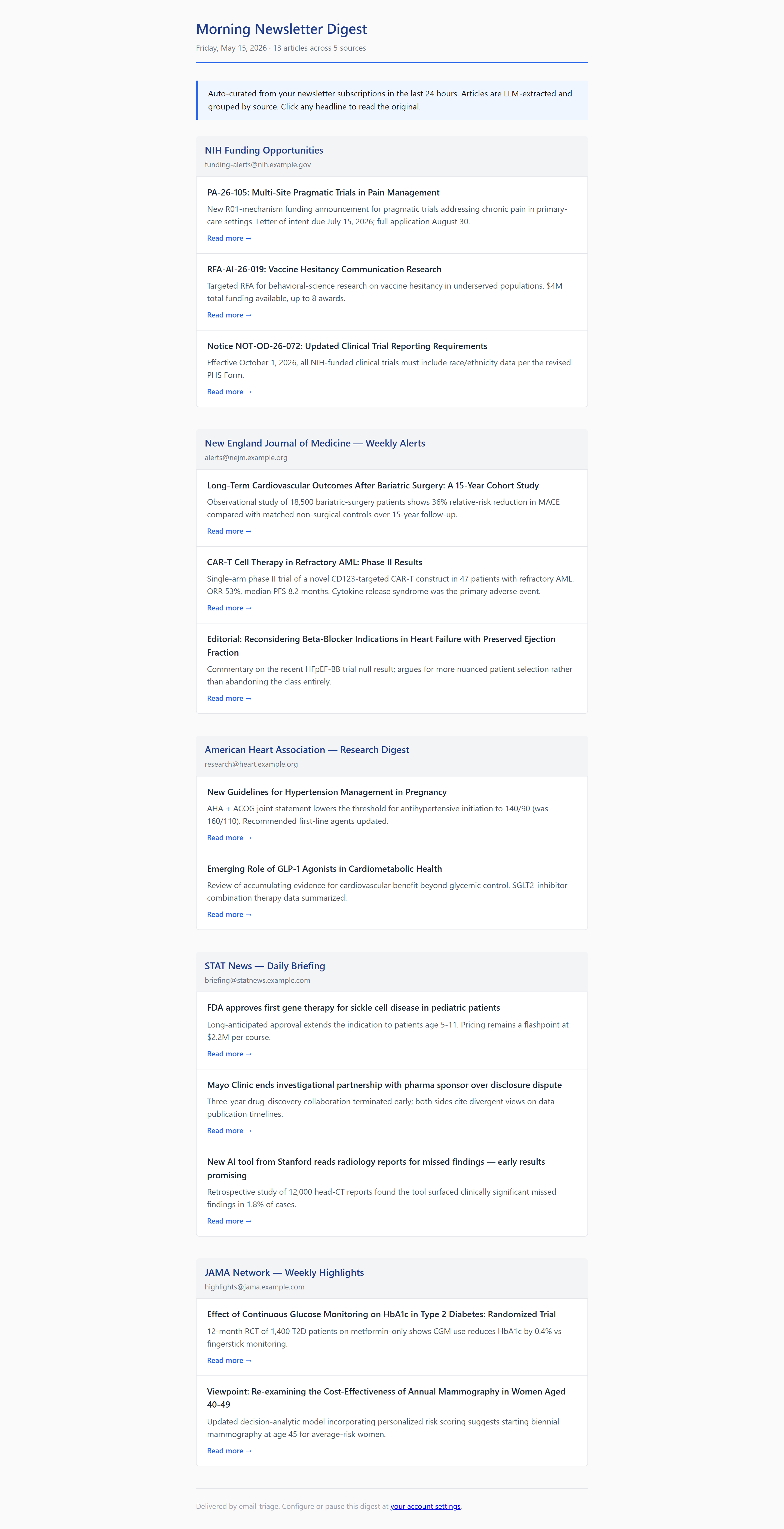
A daily 7 AM digest — 12 articles across 5 sources, scannable in 5 minutes
Inside the running system
No black-box behavior. Every category, every rule, every operational signal is visible in the admin UI.
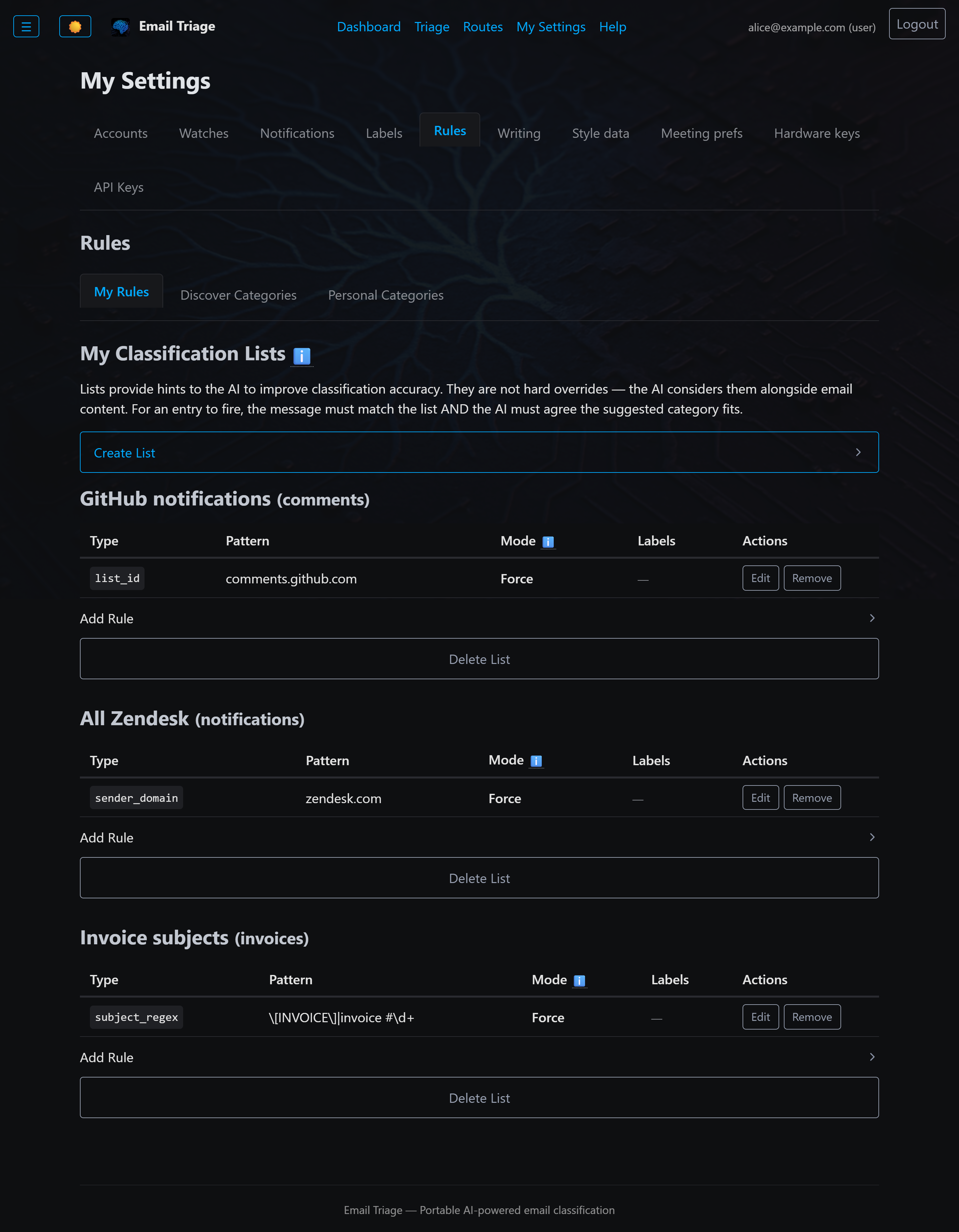
/rules — operator-controlled mailing-list, sender, and regex rules that bypass the classifier
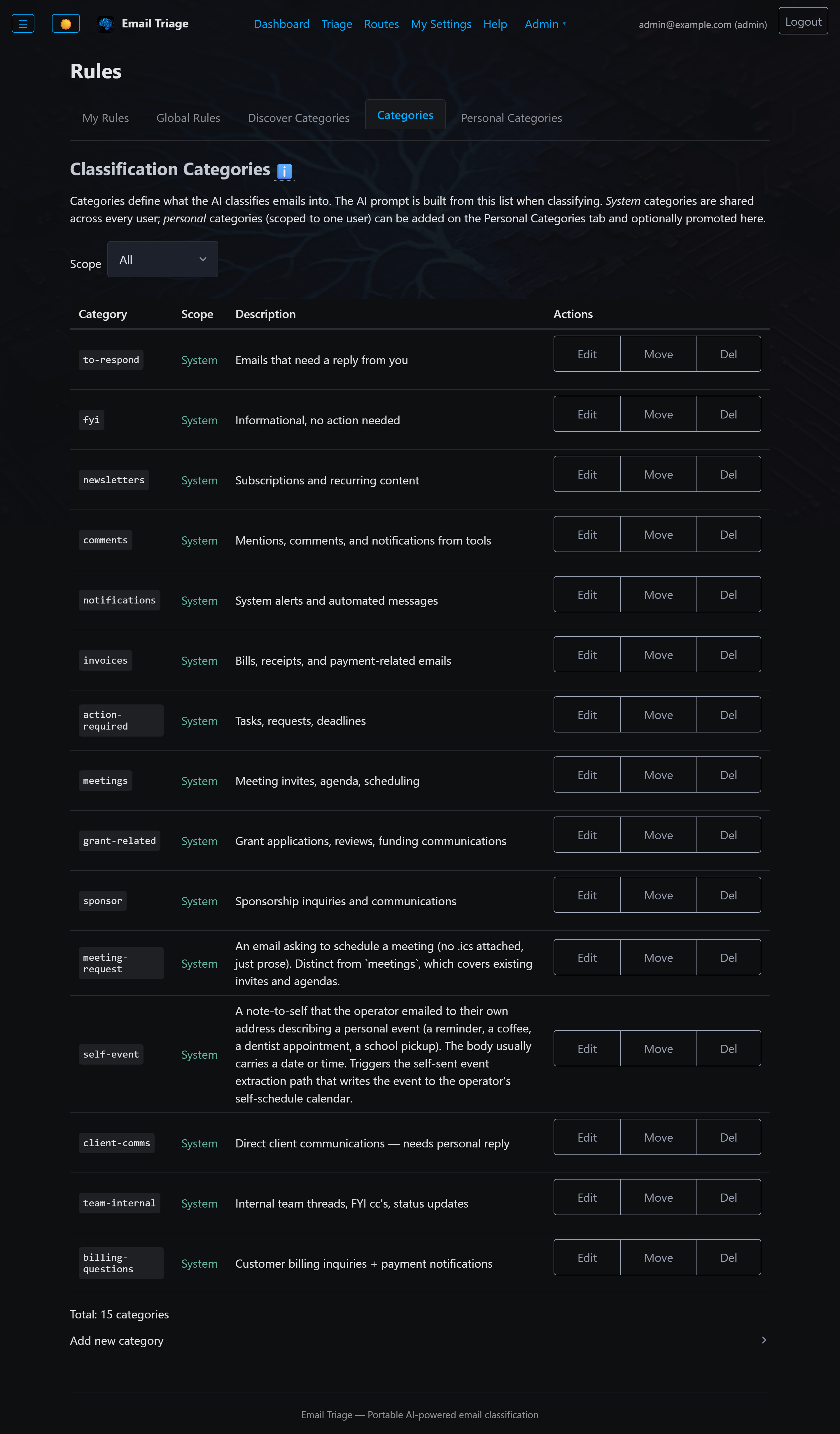
/categories — system defaults + your custom categories with editable descriptions
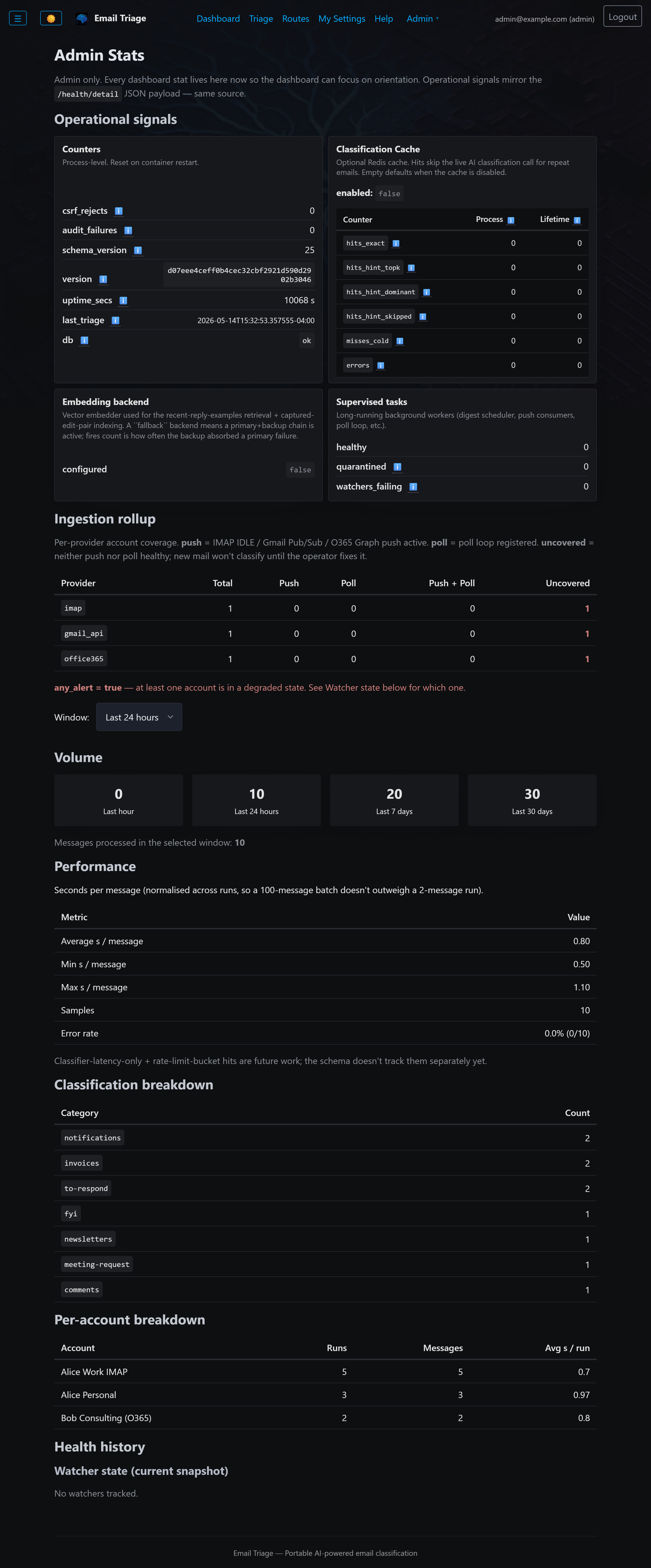
/admin/stats — classifier latency, cache hit ratio, push watcher health, supervised tasks
What lands in your inbox
Email Triage drafts; you review and send. Nothing leaves your outbox without explicit operator action.
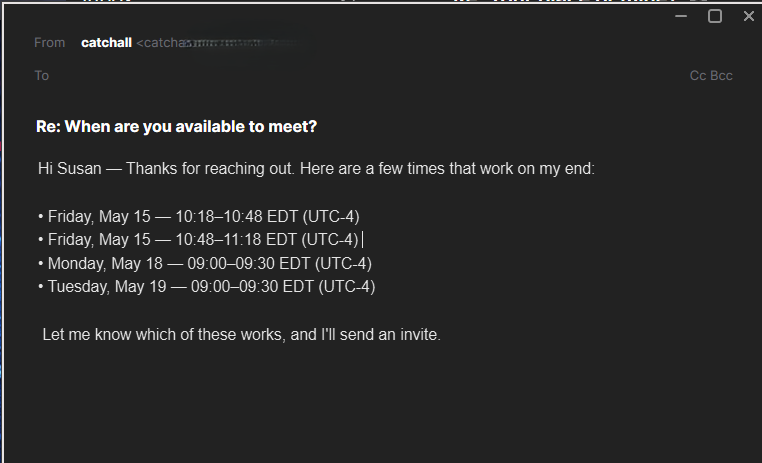
A drafted reply in the email client's Drafts folder — threaded into the original conversation, calendar-aware, ready for review
Service Offering
The product is open-source self-hostable. The service offering wraps it in implementation, customization, and ongoing operation.
Use cases
High-volume sponsor/IRB/manuscript inbox. HIPAA-aware. Daily digest collapses noise, surfaces what needs response.
HIPAA-regulated by default. Audit chain on every staff access. Drafted patient correspondence for clinician review.
Multiple client mailboxes with isolation. Per-client style profiles. Meeting-request intercept across engagements.
Podman + Tailscale + Ollama on a GPU you own. Self-service deployment with the same compliance posture as enterprise.
Verify it yourself
The product is real, the supply chain is auditable, and the install is buildable by your own ops team — no service tier required to deploy.
Apache 2.0. Read the code, fork it, audit it.
Cosign-signed (keyless OIDC) with SLSA-3 provenance and a separate operator-attestation. HIPAA installs verify both attestations on the same digest before pull.
ghcr.io/unlimited-data-works-llc/email-triage
Hash-pinned embedding-runtime tarball with SHA-256 sidecar. Sideload through the admin UI; same verification as the auto-download path.
A 30-minute call helps identify whether Email Triage fits your stack, your compliance posture, and your team's workflow.